Share this page


Work with the integration
This topic describes how to integrate with OpenText Application Quality Management.
Prerequisite: Connect
To perform any of the steps in this task, you must first connect to OpenText Application Quality Management.
- From the main menu, select ALM > ALM Connection.
- Enter the OpenText Application Quality Management URL, in the following format:
<ALM server name or IP address>:<port number>/qcbin. - Enter a username and password for connecting to the server. Click Connect.
- Select an OpenText Application Quality Management domain and project, and click Login.
- Select Restore Connection on Startup to automatically log in to OpenText Application Quality Management each time you start the OpenText Service Virtualization Designer.

Save a virtualization project
You can save new and existing projects in OpenText Application Quality Management.
To create a new project and save it in OpenText Application Quality Management:
When you create a new virtualization project, you can choose to save the project in the file system, or in OpenText Application Quality Management.
-
From the main menu, select File > New > Virtualization Project. For more details on creating a new project, see Manage Virtualization Projects.
- In the Summary of Virtualization Project dialog box, click Change to modify the Path field.
-
In the Change Project dialog box, click the Browse button to select a place to save the new project.
-
In the Browse dialog box, select ALM Resources to save the new project on the OpenText Application Quality Management server to which you are connected.
Tip: Create a new folder under ALM Resources for your virtualization project. All project files and services will be saved under that folder.
To save an existing project in OpenText Application Quality Management:
-
In the OpenText Service Virtualization Designer, open a project that is saved in the file system.
Tip: On the Start Page, under Recent Projects, hover over a project name to see the full path to the saved project.
- From the main menu, select File > Save Project As. In the Save dialog box, select ALM Resources to save a copy of the project on the OpenText Application Quality Management server to which you are connected.
Open a saved virtualization project
To open a project saved in OpenText Application Quality Management, do one of the following:
-
From the main menu, select File > Open Project/Solution. In the Open dialog box, select OpenText Application Quality Management Resources, and select a project.
-
On the Start Page, under Recent Projects, select a project.
Tip: Hover over a project name to see the full path to the saved project. Projects saved in OpenText Application Quality Management are displayed with the [ALM-RESOURCE] prefix.
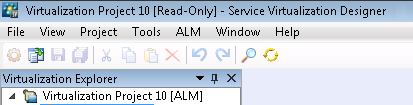
If you try to open a project that is already opened, you are notified that the project is locked by another user. If you choose to open the project, it is opened in read-only mode.
Copy a virtualization project
You can copy a OpenText Service Virtualization project stored in OpenText Application Quality Management.
- Open the project in OpenText Service Virtualization.
- From the main menu, select File > Save Project As. Select a location in OpenText Application Quality Management or in the file system, and enter a name for the new project.
Work with service templates
You can save a service as a template in OpenText Application Quality Management, and create new services from templates saved in OpenText Application Quality Management.
To save a service as a template in OpenText Application Quality Management:
- In the Virtualization Explorer, right-click the service and select Save as Template.
- In the Save dialog box, select OpenText Application Quality Management Resources, and select a folder for saving the service template.
To create a virtual service from a template saved in OpenText Application Quality Management:
-
Select one of the following:
- From the main menu, select File > New > Virtual Service From Template.
- In the Virtualization Explorer, right-click a virtualization entity and select Add > Virtual Service From Template.
- In the Open dialog box, select OpenText Application Quality Management Resources, and select a template for creating the new virtual service.
Troubleshoot lost connection
When you make changes to your project, they are saved both locally and also in OpenText Application Quality Management.
If, for example, due to a temporary loss of network connection or if the OpenText Application Quality Management machine is down, changes that are saved locally may not be saved to OpenText Application Quality Management.
The next time you open the project and are connected to OpenText Application Quality Management, the changes will be automatically uploaded to OpenText Application Quality Management.
If you want to manually synchronize with OpenText Application Quality Management when your connection is restored, from the main menu, select ALM > Upload Project Files.
Work with a version controlled project
| Open a OpenText Service Virtualization project that is saved in OpenText Application Quality Management |
If the project is currently checked in, you are prompted to check it out. If you do not want to check out the project, click No. The project is opened in read-only mode.
To check out the project at a later time, from the main menu, select OpenText Application Quality Management > Check out. |
| Check in your changes |
From the main menu, select OpenText Application Quality Management > Check in. Alternatively, in the Virtualization Explorer, right-click the project name and select Check In to OpenText Application Quality Management. |
| Save your changes without checking in | From the main menu, select File > Save. You are prompted to check in the project. If you choose no, your changes are uploaded and saved in OpenText Application Quality Management in the checked out version. |
| Discard your changes without saving | From the main menu, select OpenText Application Quality Management > Undo Check Out. |
| View version history | From the main menu, select OpenText Application Quality Management > Version History. |
For full details on working with version control in OpenText Application Quality Management, see the OpenText Application Quality Management help.
 See also: